
Categories

Banner Day for Hogs


It’s not often when you get the drop on feral swine.  I’m convinced they are some of the smartest wildlife in the state.  I’m sure they use deductive reasoning during their everyday life.  If hunted hard they turn nocturnal.  If one or two are trapped, the others in the group that witnessed the door slam shut will never be trapped.  If run by dogs, they quickly learn to never stop and fight, but to keep running and eventually wear down the chasing dogs or swim a river to get away.   Those animals are smart rascals for sure.

A couple of years ago I had a wonderful ranch leased for cattle near Rock Island, TX.  The northern one-third of the property was wide open with the exception of a few scattered wild rose hedges.  At one time, that section of the ranch was farmed for rice.  The place was flat as a pancake.

While checking cattle one evening, I spotted a pair of coyotes trotting across the prairie about 500 yards away and made a mental note of it.  I was more concerned with a corner of the field that had huge rooting holes torn through the turf.  From the size of the holes, it looked to me as if it was a solo old boar. This got my blood up.  It was time to wage war.

I learned a long time ago the swine are most active at night whenever the moon is straight up.  It was several days past the full moon which would put the moon at its zenith around dawn. The next morning I left my house early, stopped in Columbus for a donut and coffee, and then cruised slowly towards the ranch.  I had two rifles with me that morning.  One was my old Winchester Model 70 30-06 that was built in 1937.  This was for an old boar.  The other was my dad’s Sako Vixen 222 magnum.  This was for coyotes.  I was set for anything.


may 2014 005
The Arsenal

It was a clear morning, cool.  The eastern horizon was just turning silver and the tree line along Skull Creek looked like black lace against the sky.  The pale yellow moon was straight up and added a misty glow to the land.  I was oozing along the paved county road that bordered the eastern part of the ranch and thought I saw some black dots in the field with my naked eye. Binoculars showed me about 20 hogs milling about but drifting north.  I knew with the sun on its way in about 30 minutes they would be off the property heading towards the nearest heavy timber on the Glascock Ranch.  A steady south wind was blowing.  My hunter instinct took over and I planned an ambush.

I quickly did a three-point turn on the narrow county road and headed to the NE corner of the property.  Here was an old gate and gravel road that led into the middle of the pasture where an oil field location once stood.  I inched down this road not wanting to make too much crunching noise as my tires rolled on the gravel road. The hogs were about 1,000 yards away and starting to travel towards me in a more determined manner.  They had quit feeding and were heading home to their bedding area.  My  brown truck blended in with the old poisoned rose hedges that had turned a similar shade.  I circled to the north of one of the clumps of dead brush, and nosed my truck into the hedge.  Just the roof of my vehicle would be visible to the pigs.  I grabbed both rifles, eased my door shut without making a noise, then I climbed into the back of the bed.  I held the 30-06 in my hand and laid the little 222 magnum on the roof of my cab and waited.  I felt like Davy Crocket with a spare musket leaning on the Alamo parapet looking at Santa Anna’s troops marching my way!

This was a perfect trap.  The movement of the hogs looked like  a long black snake weaving but heading directly to me.  The wind was in my favor and my truck was hidden.  I had two loaded rifles with roughly 20 hogs approaching on a wide open prairie and being in the back of my truck gave me a little elevation.  This was going to be EPIC!

Closer and closer they came.  I distinctly recall their ears were flopping as they trotted towards me.  I had the crosshairs solid on the leader with no wobble on my hold when he got to within 25 yards of the truck and abruptly stopped.  He lifted his head to study something that apparently seemed unusual to his beady pig eyes. Perhaps he could see a gleam from a small part of my windshield.  The other pigs were bumping into each other as the whole group came to a stop.  That was the last thing the leader saw.  A 150 grain bullet crashed into its chest dropping him in his tracks.  That was a layup shot.

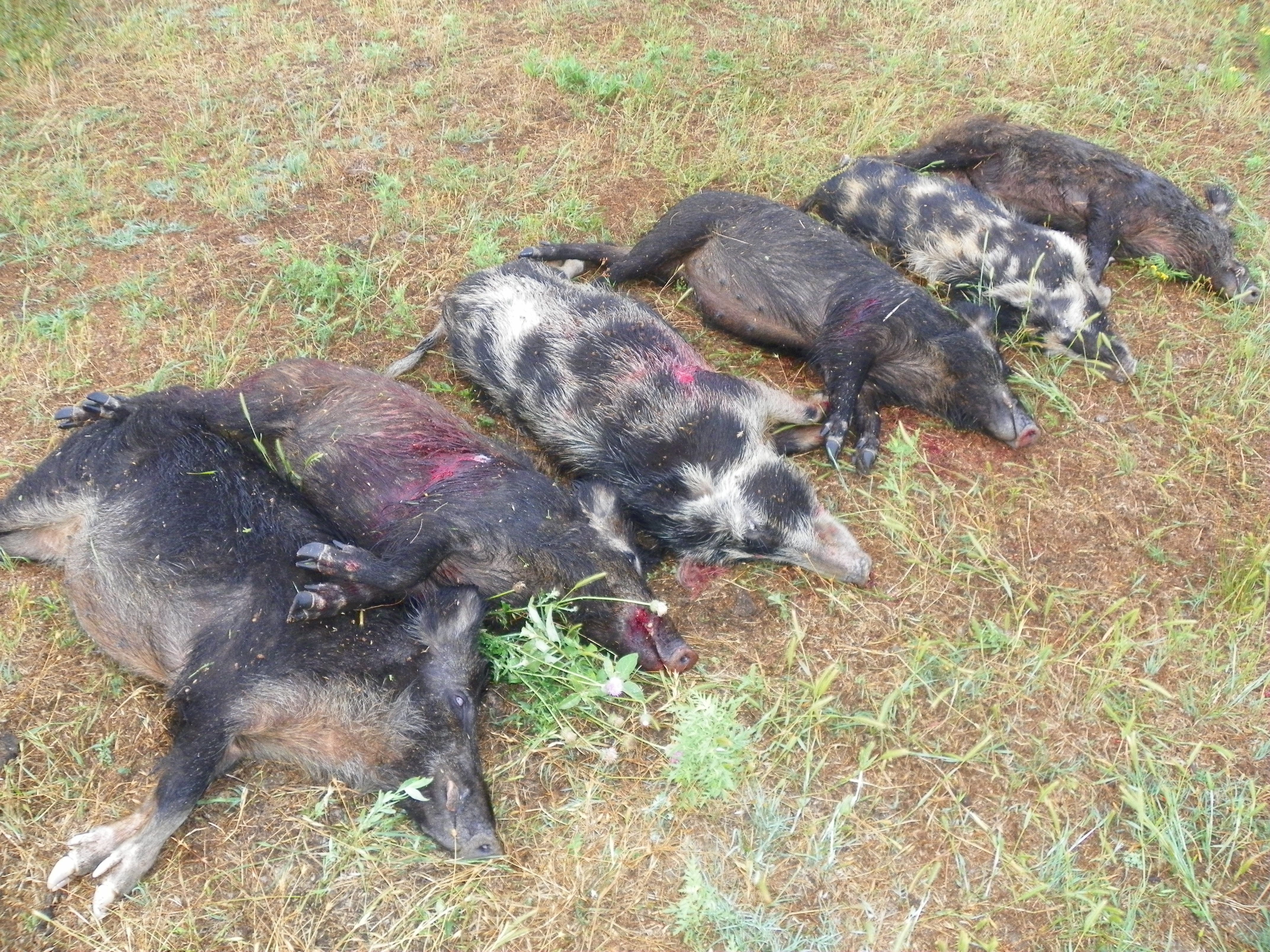
When the rifle boomed, the herd exploded to action.  Imagine a fireworks display and a star burst.  That is what happened next—pigs of all sizes ran in every direction.  I swung on a hog running to my left and dropped it.  He was only 40 yards away. Another pig was running at about a 45 degree angle on my left side and about 75 yards out and I cut down on that one.  When the bullet hit his ribs it did a flip and slid on its back in a cloud of dust and weed seeds. My fourth and last shot with the big rifle was a straight away hog that required no lead.  This guy was out about 125 yards or so.  Down it went.  Four down with four shots and three were running!  I was in a groove.

may 2014 004
The Aftermath

I laid down the empty 30-06 and snatched up the little Sako.  Now I concentrated on the right side of the truck.  By this time, the hogs were getting out there a bit, and I hate to admit it, but my first shot with the light rifle was a clean miss.  I did not lead enough or stopped my swing.  I corrected on my next attempt and rolled one that was almost 200 yards away.  My third shot with the little 222 magnum hit a hog in its flank.  This slowed the animal and gave me a chance with the final shot to dispatch it with a good hit to the chest.  I took my time on the wounded hog and planted the little 55 grain bullet right on the heart. This last pig was laying about 250 yards away. 

All of the above action took place in about 20 seconds.  Now all was quiet except for the shrill ringing in my ears from the rifle reports.  The air was spiced with burnt cordite.  I watched the survivors racing across the prairie in the distance for a bit then checked the hogs I had just shot.  All were still except for one that had a hind leg limply wind-milling the morning air in its last dying reflex escape attempt.   Slowly the leg relaxed then all were still.  There are no close neighbors to that ranch but if anyone heard the hot action, I bet they thought the Third Infantry Division was wading ashore.  Eight fast paced shots bagged six.  My first shot was standing the others running.  One clean miss and one hog took two shots to put down for good.  I was pleased and expect it to be a long time before that episode will be repeated, though I do carry more ammo now just in case.
Co-ops

A wildlife co-op is a group of adjacent landowners that manage wildlife together by pooling their acreage.  These landowners treat their combined acreage as one giant ranch.  The trendy word now is to call a co-op a wildlife management association (WMA).

 Gonzales County was home to one of the earliest WMA’s.  Another was between Brady and Mason in the Texas Hill Country.  I am not sure if either of those still exist.  The oldest WMA in what I call the “modern era” is the Harvey’s Creek WMA.  I started it.  Here is the story…………….

 Back in the mid 1980’s, the Texas Parks and Wildlife Department (TPWD) tried to streamline their method of taking antlerless deer.  TPWD wished to drop the hassle of paper permits.  “Doe Days” were introduced.  If someone owned property in an area of any county where there were Doe Days, you were allowed to kill doe without a permit any time during those days.  In areas of the county where there was a low deer density, usually only one weekend was allocated.  In areas of the county where there was a high density, sometimes up to 10 to 14 days were allocated. This method forced landowners to make a decision on how many doe were to be killed on their prospective properties.

 The Doe Day experiment resulted in an uproar of protests from landowners and hunters.  Everyone said they were going to do the right thing, but their neighbors were going to kill everything that walked.  Blame was placed on neighbors.  A lot of finger pointing was happening.  Newspaper ads and letters to the editor of local newspapers were dripping with indignation. I saw a bumper sticker that read, “Save doe, kill Wildlife Biologists!”

 I knew the problem was too many bucks being killed, not doe.  It was the perfect time to try a new approach since deer management was a hot topic.  I picked up the phone and called Mr. Dokus who managed the Hermes Ranch.  I asked him if the Hermes Ranch would work with the Holman Ranch to do a deer census, and then cobble a harvest plan together that would assure that the doe harvest not get out of hand, and more importantly assure young bucks the chance to reach 4.5+ years of age. His reply was, “Yes we will but only if you can get the Kearney Ranch to do it and I know they will have no part in that!” I called John Kearney next.  His response was, “Great idea Jack, but you will never get the Hermes Ranch to do it!”

 I used the leap-frog method from then on, calling two properties away then backing up to get the property on board that I originally bypassed.  In a single week, I put together 5,700 acres.  The following year, the co-op grew to 10,200 acres and we were up and running. I think it is close to 35,000 acres now.

 All of this was possible because the local TPWD Wildlife Biologist, Royce Jurries, was at my side giving advice and present when we had our first landowner meeting.  He led the way, promoted the idea and was a huge factor in this concept getting off the ground.  Each landowner was trained in how to determine the deer densities on their property.  Each landowner counted bucks/doe/fawns to determine sex ratios and fawn crops.  All of the data was pooled, and the combination’s average was used to determine a harvest plan that would slowly build a buck herd with older aged deer.

 As you can imagine, there was a lot of doubt from the general public.  The majority of landowners and hunters in the area literally laughed at our attempt.  Plenty of snide remarks were made at local cafes, bars and barbershops.   But that tone started to change in a few years.  Guess what?  My plan worked!

 When landowners started bagging old trophy bucks three years later, other landowners wanted to participate.  The Sandy Creek WMA was formed south of Weimar with the help of my old friend and high school classmate Edwin Anders.  The Colorado County WMA was formed downstream from Columbus.  Central Colorado County WMA started as did the Northeast Colorado County WMA.  The neatest thing was a rural housing subdivision actually formed a very successful WMA called The Oakridge Ranch WMA.

 This was not the end.  The same blueprint Harvey’s Creek WMA used was copied in other counties.  Gary Homerstad was the TPWD Technical Guidance Biologist in Victoria County and he help organize what eventually became The Texas Organization of Wildlife Management Associations (TOWMA).  Through his encouragement, WMAs spread like wildfire across the State.  At its peak, there were approximately 3.5 million acres, mostly in southeast and central Texas, that were a part of some type WMA.  Gary Homerstad was the strongest voice the State had regarding promotion of WMA’s.  He helped to literally change the way wildlife management was approached in areas with small acreage ownership.

 This concept, which grew into a movement, all started with a simple phone call.  As far as I know, that is always how these get started.  There is always one individual that believes the idea will work, then that individual contacts one landowner, and another, and another, etc.,  until a sizeable chunk of land is put together to make managing wildlife more effective.

map-1
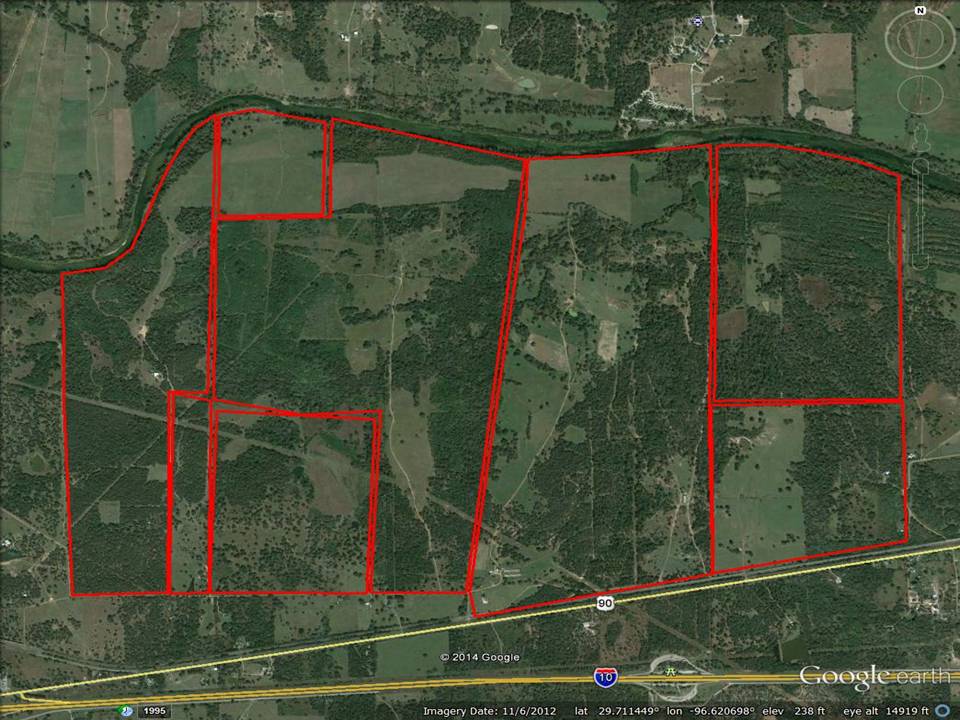
Original Harvey’s Creek WMA 1990
map-2
Harevey’s Creek WMA 2016

                                            FRAGMENTATION

Fragmentation is the term used when a landowner wills his/her property to his/her heirs.  Let’s start with 800 acres.  Grandpa leaves this to his two sons.  One son sells his portion but the other keeps his and wills it to his 4 children.  Now instead of one 800 acre tract you end up with one 400 acre tract and 4 100 acre tracts.  Each of these owners eventually produce children and they invite friends to the property to hunt.  Now the 800 acres, as far as habitat and nature is concerned, is the same.  But today you have dozens of more people roaming the ground whereas 50 years ago there was only one person using it. 

 The example maps are happening all across Texas and other states as well.  The map with red boundaries is the landowners of the original Harvey’s Creek WMA in 1990.  The green and red boundary map is the current map of landowners in 2016.  Acreage is the same for that section of the WMA but there is much more pressure being exerted on the wildlife due to fragmentation.  WMA’s are an outstanding tool to keep the harvest rates manageable.  Treat the area as one ranch.  No matter how many landowners eventually own that section of the county and no matter how many partition fences are erected, manage the harvest as if there are no fences.  People simply have to take turns

 Keep this in mind—there are three choices on how to manage land:

1.       Do nothing.  Keep doing what you have always done.  This will guarantee fragmentation will eventually swarm you under

2.       Construct a game fence

3.       Co-op