Categories

Introduce a Novice

I am extremely lucky to have had a grandfather who purchased ranches, as well as a dad that liked to hunt and encouraged me to hunt as well.  This background has given me thousands of hours spent outdoors over my lifetime.  I can recount a lot of hunting stories as my hair thins and turns grey, but I can honestly say some of the most pleasing episodes are those when I’ve introduced newcomers to the sport.

A while back, I started paying attention to the youth hunts put on by the Texas Wildlife Association.  It is a structured event where guides follow strict rules setting examples to new hunters, while at the same time promoting ethics.  I arranged for a “guide school” at our camp house and got a few friends of mine to attend. There is a lot of red tape involved with TWA, so we eventually split off from that organization but we continue to follow their blue print nonetheless.

Here is my team:  James Janda, Tony Janda, Alvin Emmel and I are the guides from Weimar. Richard Grobe, my Texas A & M classmate and resident of Columbus is the last guide.  Daria Emmel (Alvin’s wife) is the cook.  We’ve been together dozens of times.  We started by hosting hunts at our ranches and neighboring ranches.  There we were able to smooth out the rough edges to the process.  Later, we hunted in Medina County on ranches I had sold to clients.  Tom Arnett and Jim Thompson both of Houston graciously hosted us, and then later we hunted on another of Mr. Arnett’s properties in Kinney County south of Brackettville.  Our last hunt was on Randle Jones’ Diamond J Ranch in western Mason County.  Each of these ranches had spacious headquarters that allowed these youth hunts to be run in style. It takes a lot of space since not only do you have five guides and a cook, but you have five young hunters and their guardians.  It takes a minimum of 16 people just to take 5 hunters.  

Follow me on how this unfolds:

The first thing I do is contact the Weimar ISD and then Columbus ISD staff.  My goal is to get recommendations of good families that have children from 10 to 13 years old that have never hunted and do not have a deer lease or any relatives that hunt.  We target youth that have never hunted but are game to try.  Children too young can’t hold a rifle well, and kids in high school already have sap rising and are often too interested in holding hands with other hunters of the opposite sex to concentrate on deer.  We take both male and female hunters so you have to be careful.

Once selected, each hunter must purchase a Texas hunting license and they will be expected to pay for their share of the groceries.  Our last hunt cost each person $18.00 for the entire weekend.  Next, they have to pass a proficiency test with a rifle.  We arrange for the new hunter and his/her guardian (parent, grandparent, aunt or uncle) to meet at our camp house and learn to shoot.  Many of these children have never held a rifle.  I’m talking not even a .22 rim fire.   Each guide is responsible for their shooting instructions and they will provide a weapon.  Most of us use 223, 22-250, 243 or 6mm Remington. 

We’ve never had trouble with these newcomers skill.  It’s simple, they listen.  We teach them safe handling, how to support the rifle, how the rifle works, how to aim, the importance of trigger squeeze and deer’s anatomy.  When the child can regularly hit a pie plate at roughly 75 yards, they are then patted on the back and pronounced ready for the real deal.

The big day finally arrives and everyone meets after school then caravans in separate vehicles to the chosen ranch. We hunt Saturday morning and evening.  During the middle of the day it is all busy time with no lounging around the headquarters watching TV or playing video games.  The new hunters help cleaning game, then Tony Janda gives them his gun safety talk.  We do this in the field to demonstrate crossing fences etc. with a rifle.  I go to school with them and walk a bit out in the brush teaching them about what a deer eats and what he does not eat.  I go into some simple biology about deer habits and feeding routines.  Any extra time is spent gathering fire wood.

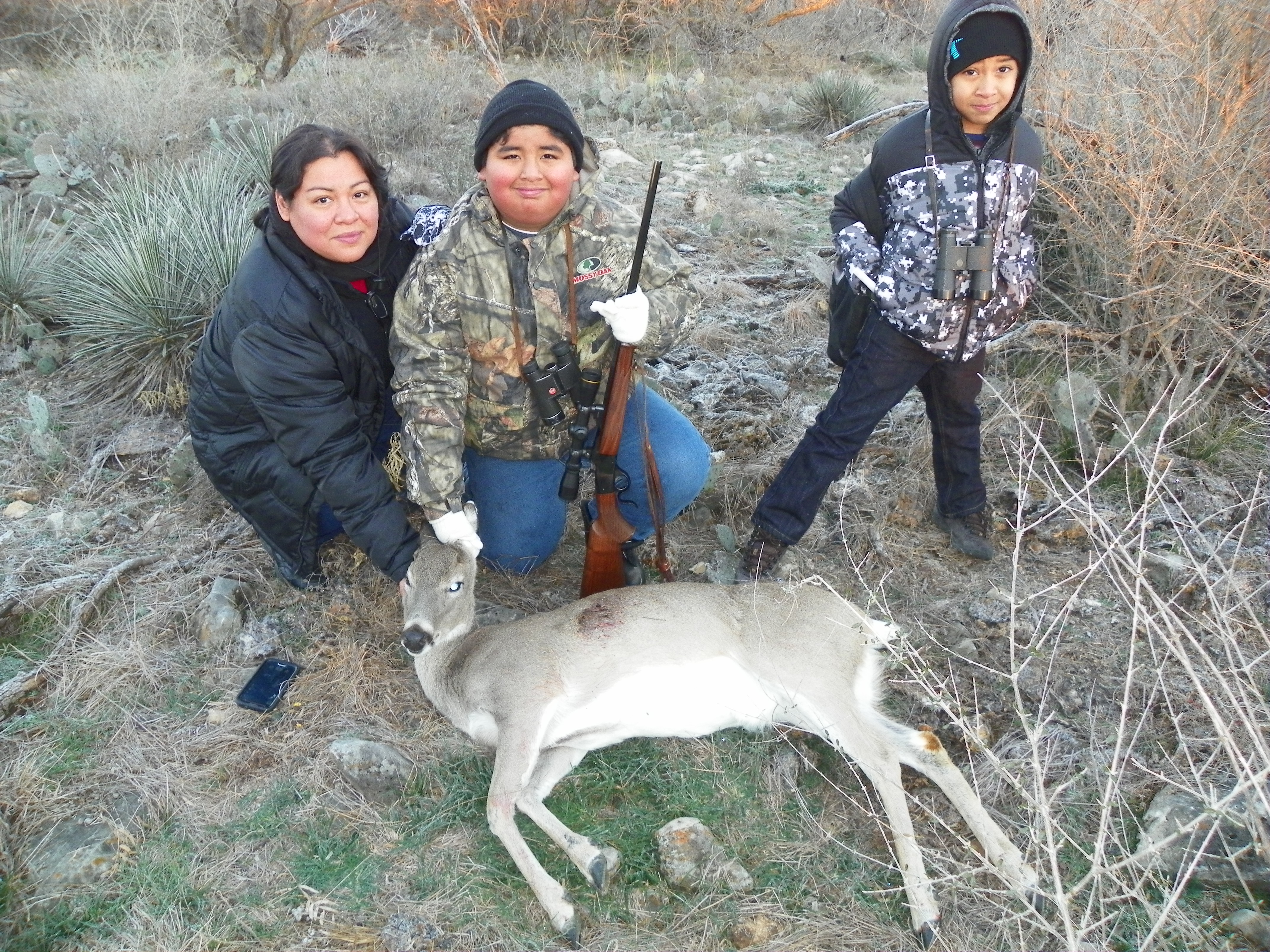
After the evening hunt and meal is the best part of the weekend.  All guides, guardians, cook and hunters gather in a circle around the campfire and one by one tell their story.  How they saw the deer approach, the number of doe and bucks each saw, how big the bucks were, how they waited for a good presentation, how they shot the deer, how they followed a blood trail, how they shook afterwards, the excitement and funny episodes are all rehashed.  No one is talking over each other but each having the spotlight alone.

January 2017 002
Success!

Even if they get a deer, they still return to the blind to observe wildlife.  We hunt again Sunday morning then everyone pitches in the clean the facilities, haul off trash, stack the remaining firewood and the last thing before leaving is to write thank you letters to the owner.

You never forget your first deer just like you never forget your first kiss.  I’ve been lucky in having given a lot of children the chance to experience deer hunting that may never have gotten the opportunity.  I was sitting at their side when they succeeded.  I am honored to have provided this chance and hope they remember me along with the animal.

PS:  Anyone reading this that has a child or grandchild between 10-13 years old that has never hunted and would like to try it please email me at jack@ranchlocator.com.  I will put you in my data base for future hunts.

The Nursery

CHAPTER ONE:

 It was New Year’s Day.  No, let me back that up some.  It was about eight o’clock in the morning on New Year’s Day. My ears were still ringing from the band that played too loudly the night before and my head could feel a pulse, plus my stomach was still slightly off of level with a hint of a hangover.  I wanted to make my rounds feeding cattle and be home near noon to take in the series of bowl games.  While driving past a lease pasture of mine on the way to our River Ranch, I noticed all cattle were up and grazing but one.  She was stretched out flat on her side.

 I rolled some hay out at the River for the mommas there, plus the heifer pasture, then took a bale back to my lease tract.  All of the cattle came to my call except one.  I headed over to the down cow and found her in trouble.

 She was on her right side and did not try to stand when I approached.  All I could see was the tip of a calf nose and two front hooves protruding from her.  At least the calf was positioned correctly.  I grabbed hold of the calf’s front hooves and pulled and moved the calf about three inches but that is all I could do.  Luckily, I had some nylon cord that was about a half-inch wide and fairly long in the back of my truck.  I drove the nose of my truck right up to the rear of the cow and tied the cord around the calf’s front feet then to my bumper.  When I took the slack out I was far enough away to see the cow while craning my neck to see over the truck’s hood.

Rocky 1
Rocky after he was pulled

  I then S L O W L Y backed up inch by inch. The cow stiffened her rear legs out but the calf slid out with no problem.  I expected the worst.  The calf had to be dead from its appearance.  No telling how long it was trapped in the cow’s birth channel.  His head was freakishly misshapen and swollen to twice the size and its tongue was bigger than normal with purple dots here and there lolling out the side of its mouth.  When I approached to take off the nylon cord, low and behold the thing blinked its eye at me.  I went back to my truck and got a couple of thick paper shop towels and wiped the mucus out of the calf’s nose and mouth.  It blinked its eyes another time then I depressed its ribs and it made a slight barely audible cough and I noticed its nose flare with its first breath.  Well look at this!

Rocky 2
Rocky about an hour later

 I drove back to our camp house to retrieve a bottle.  When I returned to the patients, the cow was still stretched out on her side so I slowly approached her, patted her side a bit, then reached down and milked the two teats I could reach and retrieved perhaps three or four ounces of precious milk containing the important colostrum that all baby calves need.  That was easy but getting it down this deformed calf head was a problem.  The calf had a feeble suck reflex, but due to its swollen head, mouth and tongue, nothing was going down.  It could barely swallow.  I knelt by its side, held the head up, and slowly and methodically pressed its lower jaw/tongue against its upper palate working milk out of the bottle.  Once every minute or so the poor thing would swallow so I guess a little milk was working its way home.

 Goodbye football games.  Goodbye nice noon meal.  I stayed with that poor calf from mid-morning until around four o’clock in the afternoon.  After about two hours, the momma struggled to her feet and wobbled off.  She had a pinched nerve and limped badly but she could travel fast enough that my milk supply was gone. It didn’t matter.  I did not think the calf would live.

CHAPTER TWO:

 About a week later, at the River Ranch, I noticed a cow that appeared to have twins.  She was alone and had two babies that although I never saw both nursing, were acting like they belonged to the single cow.  The next day both were still near the same cow.  How cool is that?

 The weekend rolled around and it was a pretty day so my daughter Kate and I were tootling around in my Polaris Ranger looking at the cattle.  When I found the cow that supposedly had twins there was only one baby obviously attached to her and a different cow was at her side worrying over a calf.  I told Kate I guess I was wrong about the twins since this momma clearly belongs to the other calf.  Keep in mind calves were dropping all over the place.  About 20 calves had hit the ground in two weeks.  All were from the same bull.  Do you think he was busy? 

 A few more days passed and when I came to the ranch in the morning, low and behold there is a starving drawn up baby calf about one mile from the pasture the cows were in and it was following my horses trying to nurse (to the amusement of my horses!).  It was weak as a noodle with flanks caved in.  Here was the other twin. 

 Unfortunately, cows can’t count.  One of the twins likely took a nap while the other sibling and mother moved off.  The cow is content having one calf nursing and she continues about her routine while the other baby wakes up, calls for momma but due to distance or wind she can’t hear and the napping twin gets left behind. 

 I think this calf nursed for a couple days and then had roughly 3-4 days of nothing.  The poor animal wandered around aimlessly and luckily saw some animals to approach, so I found it in our horse trap.  I prepared a bottle and it readily gulped the entire package.  By this time, the calf had lost its peculiar smell. The momma did not recognize him so she would not have anything to do with the stranger.  It was up to me to be the nurse maid.


bottle calves 004
Feeding the babies with my dog Bonnie (back) and neighbor’s dog BB standing guard


My nephew, Tye Gunn, named the first calf “Rocky” because he is a fighter.  To come back and survive the rough start he had is miraculous.  I named the second calf “Deuce” since it is a twin.  My wife and I bottle feed both at our home.  Both come to my driveway early morning then again late evening for their 2-3 quart feeding.  Often, Rocky walks over our shallow cattle guard drive way and follows me into the yard and I actually close the door on his nose while he tries to follow me into my home office where I now sit typing these words.


Banner Day for Hogs


It’s not often when you get the drop on feral swine.  I’m convinced they are some of the smartest wildlife in the state.  I’m sure they use deductive reasoning during their everyday life.  If hunted hard they turn nocturnal.  If one or two are trapped, the others in the group that witnessed the door slam shut will never be trapped.  If run by dogs, they quickly learn to never stop and fight, but to keep running and eventually wear down the chasing dogs or swim a river to get away.   Those animals are smart rascals for sure.

A couple of years ago I had a wonderful ranch leased for cattle near Rock Island, TX.  The northern one-third of the property was wide open with the exception of a few scattered wild rose hedges.  At one time, that section of the ranch was farmed for rice.  The place was flat as a pancake.

While checking cattle one evening, I spotted a pair of coyotes trotting across the prairie about 500 yards away and made a mental note of it.  I was more concerned with a corner of the field that had huge rooting holes torn through the turf.  From the size of the holes, it looked to me as if it was a solo old boar. This got my blood up.  It was time to wage war.

I learned a long time ago the swine are most active at night whenever the moon is straight up.  It was several days past the full moon which would put the moon at its zenith around dawn. The next morning I left my house early, stopped in Columbus for a donut and coffee, and then cruised slowly towards the ranch.  I had two rifles with me that morning.  One was my old Winchester Model 70 30-06 that was built in 1937.  This was for an old boar.  The other was my dad’s Sako Vixen 222 magnum.  This was for coyotes.  I was set for anything.


may 2014 005
The Arsenal

It was a clear morning, cool.  The eastern horizon was just turning silver and the tree line along Skull Creek looked like black lace against the sky.  The pale yellow moon was straight up and added a misty glow to the land.  I was oozing along the paved county road that bordered the eastern part of the ranch and thought I saw some black dots in the field with my naked eye. Binoculars showed me about 20 hogs milling about but drifting north.  I knew with the sun on its way in about 30 minutes they would be off the property heading towards the nearest heavy timber on the Glascock Ranch.  A steady south wind was blowing.  My hunter instinct took over and I planned an ambush.

I quickly did a three-point turn on the narrow county road and headed to the NE corner of the property.  Here was an old gate and gravel road that led into the middle of the pasture where an oil field location once stood.  I inched down this road not wanting to make too much crunching noise as my tires rolled on the gravel road. The hogs were about 1,000 yards away and starting to travel towards me in a more determined manner.  They had quit feeding and were heading home to their bedding area.  My  brown truck blended in with the old poisoned rose hedges that had turned a similar shade.  I circled to the north of one of the clumps of dead brush, and nosed my truck into the hedge.  Just the roof of my vehicle would be visible to the pigs.  I grabbed both rifles, eased my door shut without making a noise, then I climbed into the back of the bed.  I held the 30-06 in my hand and laid the little 222 magnum on the roof of my cab and waited.  I felt like Davy Crocket with a spare musket leaning on the Alamo parapet looking at Santa Anna’s troops marching my way!

This was a perfect trap.  The movement of the hogs looked like  a long black snake weaving but heading directly to me.  The wind was in my favor and my truck was hidden.  I had two loaded rifles with roughly 20 hogs approaching on a wide open prairie and being in the back of my truck gave me a little elevation.  This was going to be EPIC!

Closer and closer they came.  I distinctly recall their ears were flopping as they trotted towards me.  I had the crosshairs solid on the leader with no wobble on my hold when he got to within 25 yards of the truck and abruptly stopped.  He lifted his head to study something that apparently seemed unusual to his beady pig eyes. Perhaps he could see a gleam from a small part of my windshield.  The other pigs were bumping into each other as the whole group came to a stop.  That was the last thing the leader saw.  A 150 grain bullet crashed into its chest dropping him in his tracks.  That was a layup shot.

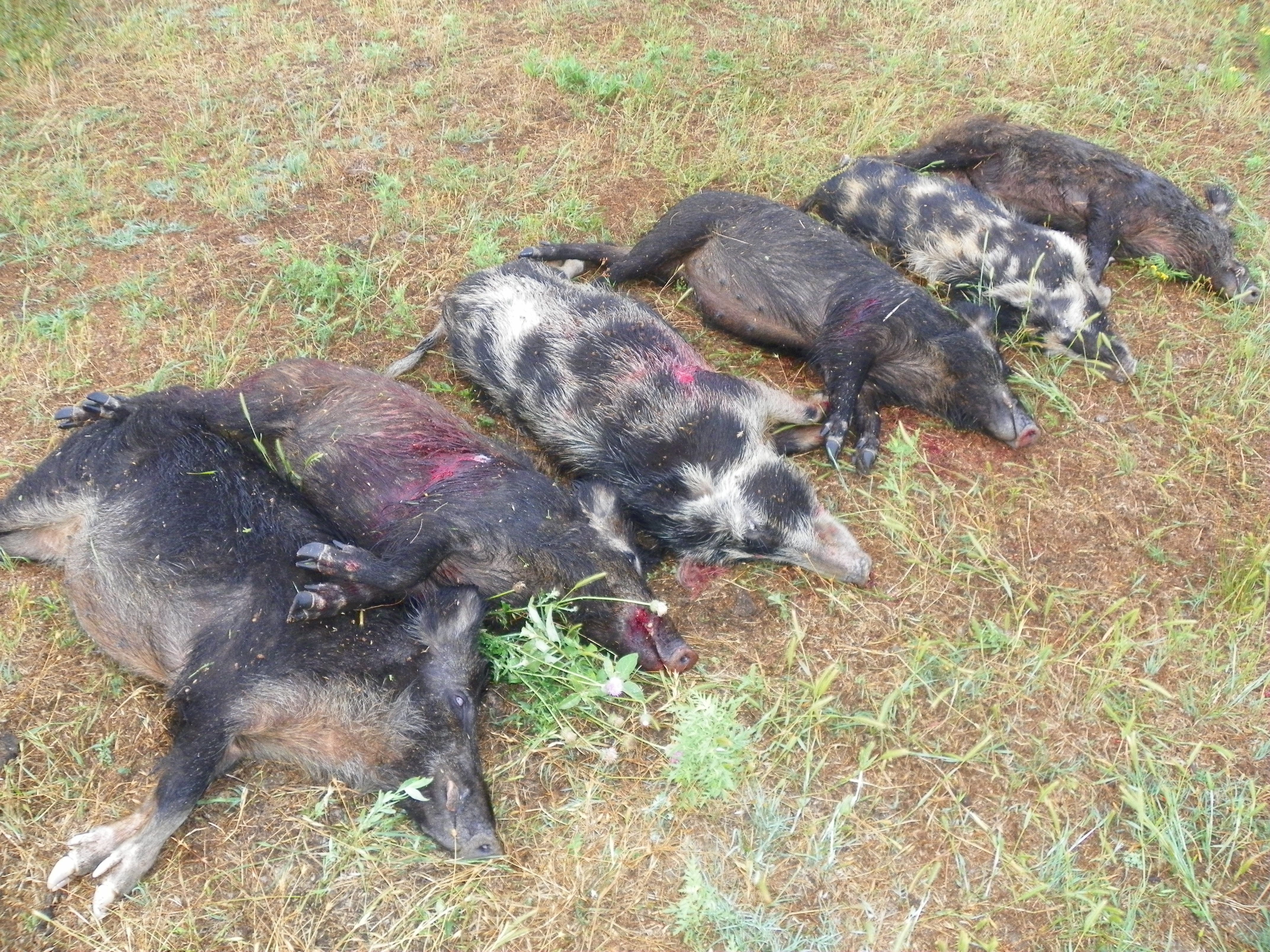
When the rifle boomed, the herd exploded to action.  Imagine a fireworks display and a star burst.  That is what happened next—pigs of all sizes ran in every direction.  I swung on a hog running to my left and dropped it.  He was only 40 yards away. Another pig was running at about a 45 degree angle on my left side and about 75 yards out and I cut down on that one.  When the bullet hit his ribs it did a flip and slid on its back in a cloud of dust and weed seeds. My fourth and last shot with the big rifle was a straight away hog that required no lead.  This guy was out about 125 yards or so.  Down it went.  Four down with four shots and three were running!  I was in a groove.

may 2014 004
The Aftermath

I laid down the empty 30-06 and snatched up the little Sako.  Now I concentrated on the right side of the truck.  By this time, the hogs were getting out there a bit, and I hate to admit it, but my first shot with the light rifle was a clean miss.  I did not lead enough or stopped my swing.  I corrected on my next attempt and rolled one that was almost 200 yards away.  My third shot with the little 222 magnum hit a hog in its flank.  This slowed the animal and gave me a chance with the final shot to dispatch it with a good hit to the chest.  I took my time on the wounded hog and planted the little 55 grain bullet right on the heart. This last pig was laying about 250 yards away. 

All of the above action took place in about 20 seconds.  Now all was quiet except for the shrill ringing in my ears from the rifle reports.  The air was spiced with burnt cordite.  I watched the survivors racing across the prairie in the distance for a bit then checked the hogs I had just shot.  All were still except for one that had a hind leg limply wind-milling the morning air in its last dying reflex escape attempt.   Slowly the leg relaxed then all were still.  There are no close neighbors to that ranch but if anyone heard the hot action, I bet they thought the Third Infantry Division was wading ashore.  Eight fast paced shots bagged six.  My first shot was standing the others running.  One clean miss and one hog took two shots to put down for good.  I was pleased and expect it to be a long time before that episode will be repeated, though I do carry more ammo now just in case.

Aging Deer

Anyone wishing to grow trophy whitetail deer knows one of the main ingredients of getting a buck to maximum size is age.  From a fawn until a deer reaches 3.5 years old, the deer’s body is still developing so a large portion of its nutritional intake goes toward growing muscle and bone.  Think of a 3.5 year old buck as being a teenage person.  Once the buck reaches 4.5 years old, its frame is basically through growing and now most of the bucks food can be funneled towards antlers. Bucks that are 4.5 years old deer = 21 year old man.

 It’s pretty obvious, even to a rookie hunter, the difference between a 1.5 year old deer vs. a trophy is pretty obvious–no brainer.  It is also pretty easy to determine a 2.5 year old buck from an older one. The problem lies in the average hunter being able to make a fairly sure estimate on a 3.5 year old buck vs. a 4.5+ year old buck.  This is where most mistakes are made.  A landowner or ranch manager has invested 3.5 years into a nice looking buck with eye-catching antlers but that deer needs that extra time to really bloom into a heavy, dark antlered trophy.  Most hunters look at antlers, and if excited, fire away.  What a shame.  That buck was almost there regarding antler potential but he certainly won’t grow more with a bullet through his lungs.

There are a lot of indicators to help determine age, and most of them require focusing on the animal’s BODY.  Neck size, how the neck relates to the shoulders, sagging stomach, swayed back and loose facial skin are good clues but most of those traits really take practice and a keen eye.  The average person that hunts casually a few times a year lacks the expertise to use many of the above methods.

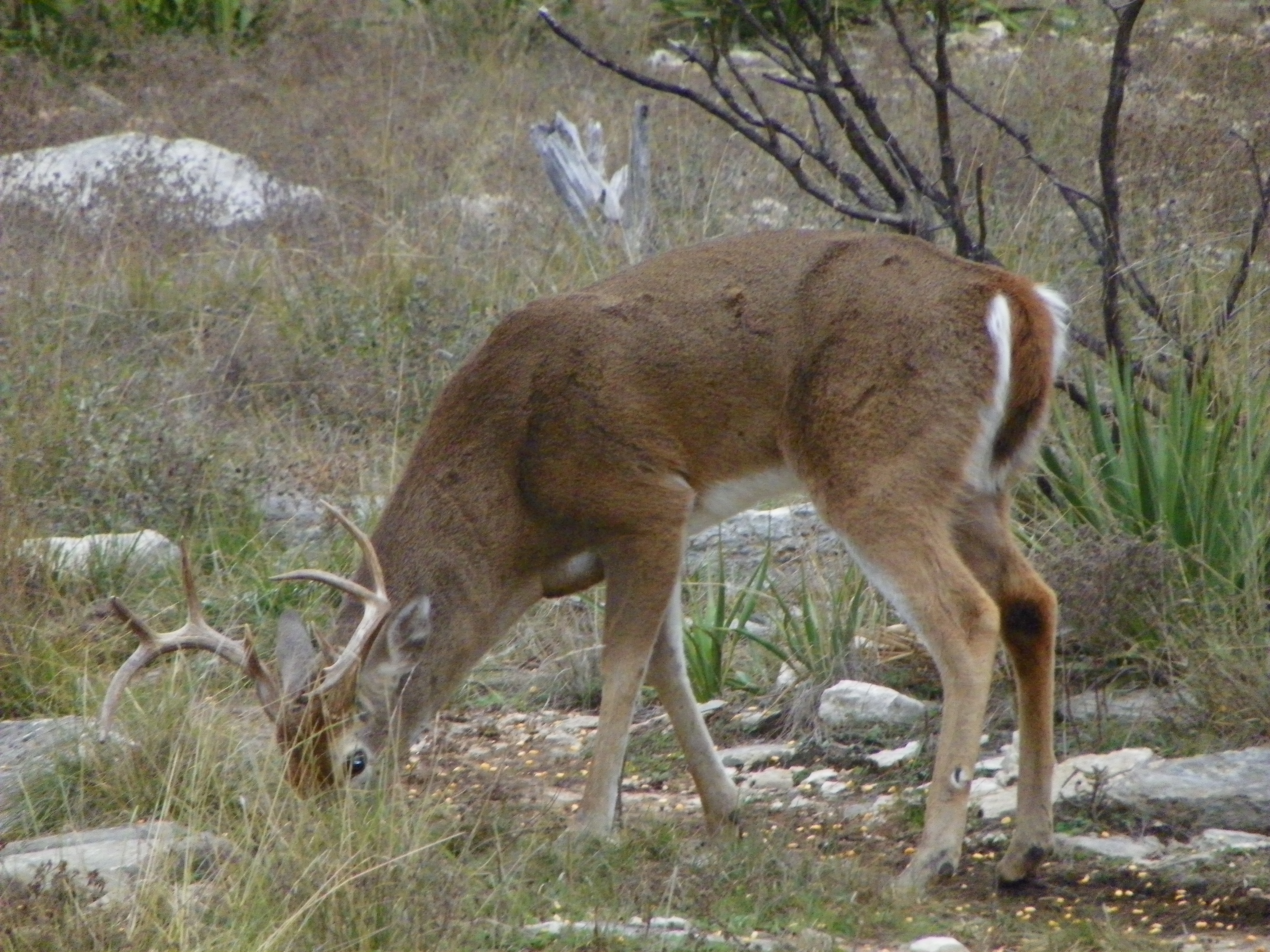
The one trait I use more than any other when trying to determine the age of a whitetail buck during the hunting season and when the rut is either over or taking place is the tarsal gland.  The tarsal gland is on the inside of what most laymen would call a deer’s back knee. (The true knee is actually higher on the leg bone).

Part of the courting ritual for whitetail bucks is making scrapes.  Scrapes are basically areas about the size of a small welcome matt at your back door where a deer paws away grass and weeds making a clean spot on the soil.  He next hunches his rear legs together and semi-squats while urinating over this gland on the inside of his back leg.  His urine mixed with glandular secretions is the olfactory fingerprint of each buck.  I will not go into the rut ritual at this point but simply wanted to give a background to this gland.

2-5
2.5 year old deer
3-5
3.5 year old deer


4-5
4.5 year old
5-5
5.5 year old deer (note streaks going down legs, down to hooves)


Here is what you should remember –

A 2.5 year old buck will have a tarsal gland that is tan and might even have white edges.

A 3.5 year old buck will have a tarsal gland that is dark but probably has a few light hairs around the edge.  There may be faint staining below the gland but not heavy.

A 4.5 year old buck will have a black gland.  There will be absolutely no white hairs along the fringe of the gland.  The gland itself will appear larger plus there will be a very noticeable staining streak running down each rear leg under the gland itself.  The streaking is important.  If there is a stain running down that buck’s leg, he is mature.

A 5.5 and 6.5 plus year old buck will have a very black gland.  It will be large, about the size of the bottom of a soda water can.  The stain running down each leg will be very prominent and the discolored hair will reach all the way to the deer’s hooves.  It often appears as a black line down the back of each leg.

 This gland is one of the easiest indicators of age.  The appearance of the buck’s tarsal gland has never proved me wrong.

Co-ops

A wildlife co-op is a group of adjacent landowners that manage wildlife together by pooling their acreage.  These landowners treat their combined acreage as one giant ranch.  The trendy word now is to call a co-op a wildlife management association (WMA).

 Gonzales County was home to one of the earliest WMA’s.  Another was between Brady and Mason in the Texas Hill Country.  I am not sure if either of those still exist.  The oldest WMA in what I call the “modern era” is the Harvey’s Creek WMA.  I started it.  Here is the story…………….

 Back in the mid 1980’s, the Texas Parks and Wildlife Department (TPWD) tried to streamline their method of taking antlerless deer.  TPWD wished to drop the hassle of paper permits.  “Doe Days” were introduced.  If someone owned property in an area of any county where there were Doe Days, you were allowed to kill doe without a permit any time during those days.  In areas of the county where there was a low deer density, usually only one weekend was allocated.  In areas of the county where there was a high density, sometimes up to 10 to 14 days were allocated. This method forced landowners to make a decision on how many doe were to be killed on their prospective properties.

 The Doe Day experiment resulted in an uproar of protests from landowners and hunters.  Everyone said they were going to do the right thing, but their neighbors were going to kill everything that walked.  Blame was placed on neighbors.  A lot of finger pointing was happening.  Newspaper ads and letters to the editor of local newspapers were dripping with indignation. I saw a bumper sticker that read, “Save doe, kill Wildlife Biologists!”

 I knew the problem was too many bucks being killed, not doe.  It was the perfect time to try a new approach since deer management was a hot topic.  I picked up the phone and called Mr. Dokus who managed the Hermes Ranch.  I asked him if the Hermes Ranch would work with the Holman Ranch to do a deer census, and then cobble a harvest plan together that would assure that the doe harvest not get out of hand, and more importantly assure young bucks the chance to reach 4.5+ years of age. His reply was, “Yes we will but only if you can get the Kearney Ranch to do it and I know they will have no part in that!” I called John Kearney next.  His response was, “Great idea Jack, but you will never get the Hermes Ranch to do it!”

 I used the leap-frog method from then on, calling two properties away then backing up to get the property on board that I originally bypassed.  In a single week, I put together 5,700 acres.  The following year, the co-op grew to 10,200 acres and we were up and running. I think it is close to 35,000 acres now.

 All of this was possible because the local TPWD Wildlife Biologist, Royce Jurries, was at my side giving advice and present when we had our first landowner meeting.  He led the way, promoted the idea and was a huge factor in this concept getting off the ground.  Each landowner was trained in how to determine the deer densities on their property.  Each landowner counted bucks/doe/fawns to determine sex ratios and fawn crops.  All of the data was pooled, and the combination’s average was used to determine a harvest plan that would slowly build a buck herd with older aged deer.

 As you can imagine, there was a lot of doubt from the general public.  The majority of landowners and hunters in the area literally laughed at our attempt.  Plenty of snide remarks were made at local cafes, bars and barbershops.   But that tone started to change in a few years.  Guess what?  My plan worked!

 When landowners started bagging old trophy bucks three years later, other landowners wanted to participate.  The Sandy Creek WMA was formed south of Weimar with the help of my old friend and high school classmate Edwin Anders.  The Colorado County WMA was formed downstream from Columbus.  Central Colorado County WMA started as did the Northeast Colorado County WMA.  The neatest thing was a rural housing subdivision actually formed a very successful WMA called The Oakridge Ranch WMA.

 This was not the end.  The same blueprint Harvey’s Creek WMA used was copied in other counties.  Gary Homerstad was the TPWD Technical Guidance Biologist in Victoria County and he help organize what eventually became The Texas Organization of Wildlife Management Associations (TOWMA).  Through his encouragement, WMAs spread like wildfire across the State.  At its peak, there were approximately 3.5 million acres, mostly in southeast and central Texas, that were a part of some type WMA.  Gary Homerstad was the strongest voice the State had regarding promotion of WMA’s.  He helped to literally change the way wildlife management was approached in areas with small acreage ownership.

 This concept, which grew into a movement, all started with a simple phone call.  As far as I know, that is always how these get started.  There is always one individual that believes the idea will work, then that individual contacts one landowner, and another, and another, etc.,  until a sizeable chunk of land is put together to make managing wildlife more effective.

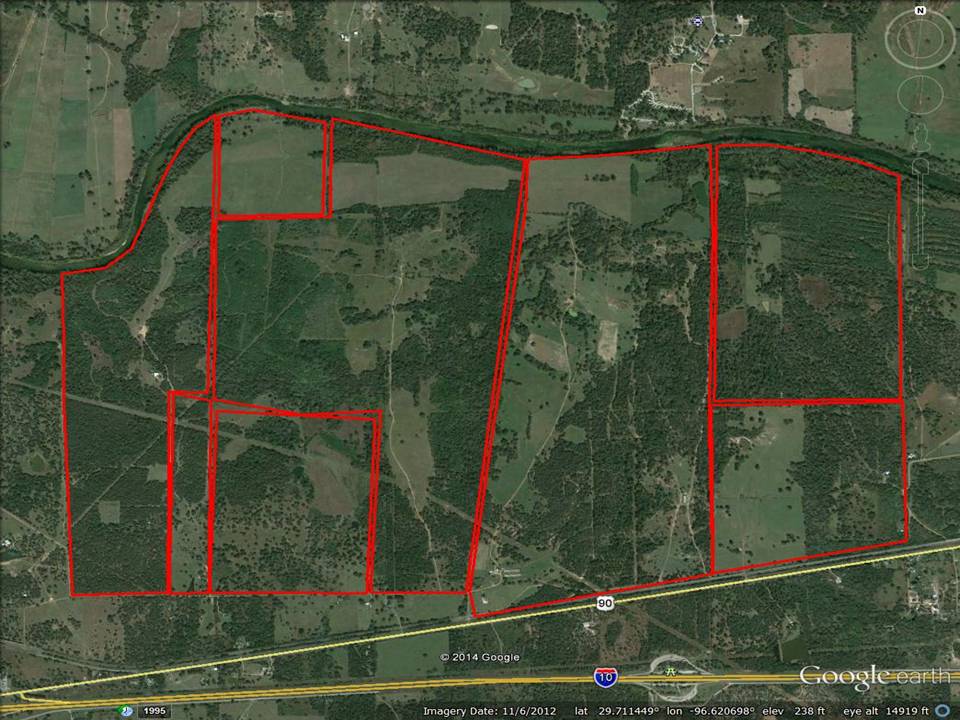
map-1
Original Harvey’s Creek WMA 1990
map-2
Harevey’s Creek WMA 2016

                                            FRAGMENTATION

Fragmentation is the term used when a landowner wills his/her property to his/her heirs.  Let’s start with 800 acres.  Grandpa leaves this to his two sons.  One son sells his portion but the other keeps his and wills it to his 4 children.  Now instead of one 800 acre tract you end up with one 400 acre tract and 4 100 acre tracts.  Each of these owners eventually produce children and they invite friends to the property to hunt.  Now the 800 acres, as far as habitat and nature is concerned, is the same.  But today you have dozens of more people roaming the ground whereas 50 years ago there was only one person using it. 

 The example maps are happening all across Texas and other states as well.  The map with red boundaries is the landowners of the original Harvey’s Creek WMA in 1990.  The green and red boundary map is the current map of landowners in 2016.  Acreage is the same for that section of the WMA but there is much more pressure being exerted on the wildlife due to fragmentation.  WMA’s are an outstanding tool to keep the harvest rates manageable.  Treat the area as one ranch.  No matter how many landowners eventually own that section of the county and no matter how many partition fences are erected, manage the harvest as if there are no fences.  People simply have to take turns

 Keep this in mind—there are three choices on how to manage land:

1.       Do nothing.  Keep doing what you have always done.  This will guarantee fragmentation will eventually swarm you under

2.       Construct a game fence

3.       Co-op

Hunting Satisfaction and Surprises

To people that have never hunted deer, they may be disillusioned by thinking all hunting is shooting and killing.  They may assume all hunts are measured by the number and size of animals taken.  Not so. 

One of the major joys of hunting deer is to get away from the pressure of jobs, the noise of crowds and the everyday demands of society.  I suppose some fishing is the same as hunting, but only when alone on a body of water and not in a crowded guide boat on a Texas bay, or certainly not in a hectic fishing tournament.  The hunting to which I’m referring is not in a tight duck blind or crowded dove field when you have an audience.  Deer hunting, specifically whitetail deer, is in most instances a solo excursion where a person is alone with nature.

 Let me tell you about one of my hunts in December of 2009.  I was invited to shoot doe and spikes on a big South Texas low fence ranch about half way between Carrizo Springs and Eagle Pass.  This property was in eastern Maverick County.  I was a guest of my nephews, Tye and Sam Gunn, and their dad, Henry.  This ranch had and still has some of the best hunting on open range in the State.  The hunters on the ranch and surrounding tracts are all on the same page regarding population control and selective culling.  Over the years I have seen quality shoot through the ceiling with this place.   

My duty was to shoot a doe or two on this trip and any spikes that were seen.  I was also assigned another role to take note of any exceptional trophy bucks seen.  The lease members each had their own blind where they regularly hunted and most had a tri-pod set up at likely spots. However, there were still hundreds of acres of basically un-hunted sections of the ranch.  That is where I headed.

 I went to an area of the property towards the northwest corner that saw little if any human activity.  I got a folding chair, a machete, a shooting stick for a rifle rest and a bag of corn.  I told my hosts I would be back after dark.  I found a spot where a road through that section made an “L” curve.  I took note of where the thickest brush was (along a creek drainage about 200 yards away) and was pleased the wind was puffing in the right direction as not to disturb any game down each leg of the road, or any deer approaching from what I suspected was the bedding spot.

 I slung corn by hand down each road leg being careful not to have it too close to where I was going to set up.  I put my chair behind a fallen mesquite tree in a little granjeno bush that more or less gave me cover in all directions.  The next thing I did was walk back into the brush to hack off several black brush limbs.  These still had dark green leaves attached and I stacked them in front of me by weaving them in and out of the mesquite limbs of the fallen tree.  The finished product was perfect.

 The wait began.  I know people that hunt deer can relate to my story now.  When I first get into the field, it takes about five minutes for me to decompress.  It seems my breathing slows, my senses sharpen and a different type of awareness takes hold.  I’m at peace.  My mind uncoils and drifts.  I tune in to the environment to catch flickers of movement and subtle changes in wildlife behaviors that begin to surround me.  Where there are no birds, raccoons or rabbits to distract me, I often think about past hunting incidents with friends and relatives.  Many times I reflect on the BIG PICTURE.  There is a lot of God in Mother Nature.  This is what keeps drawing me back.

 Well, the magic time hit and deer started to sneak out.  An unusual racked middle aged buck was feeding to my left.   He had very unique antlers so I slowly set aside my 243 and picked up my camera.  He got right on top of me and I was afraid he would see me but at the last minute, he turned back and never alerted.

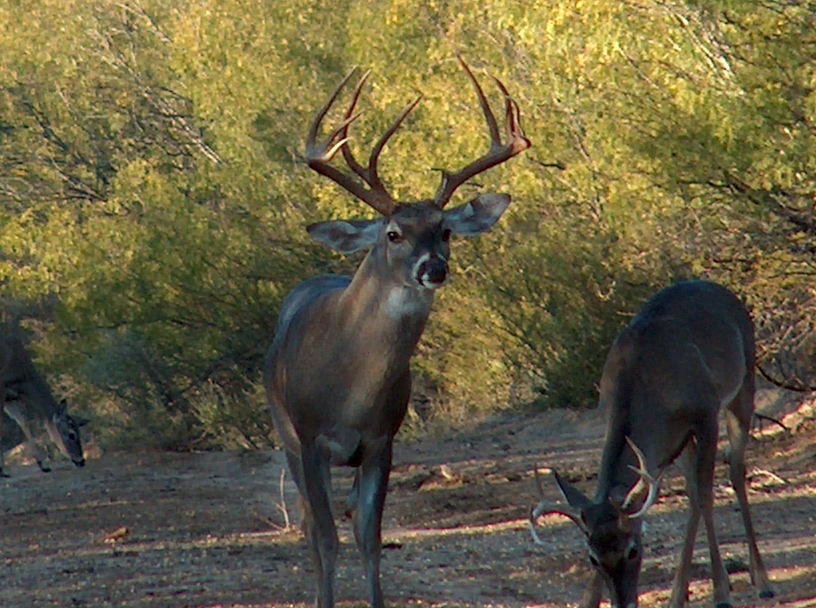
fall-2009-004When I glanced down the other road angle, my heart skipped.  There stood old Macho Man.  He was an eye catcher for sure!  As I was slowly pivoting my set up for a good photo attempt of this big guy, a movement caught my eye about five feet in front of me. A western diamondback rattlesnake was crawling towards me! 

 What happened next took place in about three seconds.  As my eyes bulged out I thought of my rifle, but perhaps a mesquite club (long handle) would work better.  I thought about jumping out of my chair.  If I jumped, what direction is best without getting tangled up in my brush hide?  Should I remain frozen while holding my breath?  At that instant, the reptile started to angle at a slight tangent to the side of my chair.  It was crawling purposefully from Point A to Point B, just traveling along I suppose looking for a wood rat to strike.  Maybe it was looking for a mate.  It was crawling slowly with little side to side fall-2009-002exaggerated movement.  It had its head slightly raised and its rattlers lifted.  It was just cruising minding its own business.  I remained frozen and tried to mind my own business.  If the snake was looking at me, I wanted him to think I was a true rattlesnake lover and that there was no death in my heart!   I’ll leave you alone if you leave me alone!  The snake was never agitated and never got into a strike position. His closest point came when he crawled by my chair.  My guess is he was three feet from me.  Three feet is one thing while looking at a yard stick but much shorter when looking at a rattlesnake!

 Well, that strategy worked.  As it went by me I thought of my camera so I snapped one photo.  When it was gone, I hate to admit it but my goose bumps and tingly feeling remained awhile.  It helped that deer were still out soI refocused on the big buck.  I got a good photo of it.

 Although there were a slew of doe out picking up corn, I let my rifle lay.  I did not wish to spook the big guy.  I already had enough excitement.  All and all, this was a very satisfying hunt with a surprise thrown in for good measure.fall-2009-005

 PS – Not until I saw the second photo of the big deer on my large computer screen did I realize a coyote was in the frame (click the photo, you’ll see).  I was focused so much on the big deer I never saw the predator.  Here was another surprise.

 Oh, and the lease hunters on this ranch were not impressed with the buck I photographed.  All took larger ones that year and all said that deer needed to grow up!

Summer Stress & Target Practice Food Plots

The hardest time for wildlife in my part of Texas is August and early September.  This is the time when the weather channel shows the giant “H” sitting over the State indicating high pressure.  90+ degree temperatures with no rain and low humidity causes dry, burnt-up grass and weeds that crackle when you walk on them.  There is a glare during the day, and whenever you do get some wind, it is a hot breath that causes the shriveled leaves to rasp and rattle. Livestock lie around loafing or standing in tepid stagnant ponds and the noise of hundreds of cicadas pierce the dead air.  I feel sorry for all plants and wildlife being heat and water stressed during the summer doldrums.  It will usually be late September before the rain showers begin to clean the dust from the atmosphere, the first northers begin to trickle down from Canada and live oak acorns begin to drop.  What saves the wildlife beginning in August?


Huisache
Huisache Bean


Mesquite
Mesquite Bean


Having a little plant diversity can make a difference.  Mesquite (Prosopis glandulosa) and huisache (Acacia farnesiana) will give deer, hogs and turkey what they need.  Remember, these plants are aggressive encroachers and if left alone, will quickly swallow up most openings.  Our family constantly attempts control of mesquite and huisache but we allow some here and there just for wildlife emergencies.

Here’s what happens.  When all warm season forbs and grasses have matured and quit growing due to drought, mesquite and huisache are just starting to drop their seed pods.  Deer and hogs love them.  The seeds are high in carbohydrates and energy just like corn.  They have beneficial protein as well.  Just like corn, animals gorge on the beans, gain weight and actually thrive when all other normal preferred food sources are gone.

Bois d’Arc Tree
“Horse Apples”


Another plant that is critical during this time is Bois d’ Arc (Maclura pomifera).  Most folks pronounce it “Boar Doc”.  Another name is Osage orange or as my grandfather used to call it, a “horse-apple tree”.  This tree will grow dozens of balls the size of grapefruits that are light green and pithy.  This tree has big leaves that begin to turn brown or yellow and slowly starts shedding during August and September.

I noticed deer standing around under Bois d’ Arc trees during the summer and discussed this one time with our local TPWD Biologist.  He said he was part of a study at one time trying to determine what deer ate during different times of the year and they had permits to harvest animals to dig into their rumens.  He found several had their stomachs packed with Bois d’ Arc leaves.  One time, I surprised a group of doe under a horse-apple tree and the last one lingered just long enough before running off to pick up one of the big green apples in her mouth.  It reminded me of a roasting pig with an apple in its mouth.

Target Practice
Target Practice

Now back to the last half of the title of these notes – target practice food plots.  My brain started to churn with an idea so I tried it out and it works wonderfully.  I parked my truck under a tree and using regular high speed 22 hollow-point bullets, began target practice by popping every horse apple I could see.  A regular bullet will not cause the “apple” to burst open so you need the more explosive bullets.  A 22 magnum worked better.  A .17 HMR or such worked even better.  Backing away to 100 yards or so and using a regular centerfire rifle varmint cartridge such as a 223 or 22-250 really caused some impressive star bursts.  If you are getting ready for deer season, which most deer hunters are doing all year long, a rifle such as a 243, 270, 308, 30-06 etc. really had spectacular terminal effects.  Dang, that was fun.  If you look at the ground under the tree, there were horse apple fragments strewn about in every direction mixed in with the leaves that were just starting to wilt and drop.

The next day, my target practice tree had several deer under it.  When I looked the ground over, most pieces of the horse apples were gone.  I tried shooting a few Bois d’ Arc balls at a different tree.  The next day deer were standing under the new tree and all pieces of the “apples” were consumed.

So, there you have it.  If you have a few Bois d’ Arc on your land, protect them.  In August and early September unlimber your rifles and have target practice.  This is just like a corn bucket spinning but you have no feed store bill and you are having fun during the process.

JH


Huisache: Acacia farnesiana
Huisache

Huisache (wee-satch) is an invasive brush species with thorns that is common in South and West Texas. In my lifetime, it has been on the march spreading into Central and Southeast Texas. About three years ago, I traveled along the Gulf Coast of Louisiana and found it thriving 50 miles east of Sabine Pass. It will not be long before our Cajun neighbors start complaining.

Wildlife and livestock do not readily browse on the leaves of huisache, but just about everything relishes the bean it produces. The bean pods begin to drop in late summer when most of the warm season grasses and weeds have matured and dried out. The old grass and weeds in late July through early September have about as much appeal to animals as broom straw. Cattle, horses, goats, deer, feral swine, raccoons, and just about every seed eating bird in the world relish the beans that huisache produce. This is Mother Nature to the rescue giving animals a tasty food source right when other options are gone. Once the bean passes through the respective digestive tracts, wherever the end If you are all in for wildlife, then I guess huisache should be left alone. If you are in the cattle business or, like our family, try to balance livestock and wildlife, then huisache has to be controlled or it will overwhelm you. The neighboring place to the west of our family’s ranch has all of the openings basically swallowed up with huisache (see header photo). That is the festering breeding grounds for the spread of this plant in my neighborhood. All of my life, our family has had to constantly spray brush each summer as the new plants appear. That is the only way to keep your land clear of this invasive plant.

There is one odd thing about huisache that I have observed but not found much to read on the subject. You never see new plants sprouting under the canopy of existing mature stands of huisache. It appears new seedlings are sensitive to shade and will not emerge there. Give the little devils sun light and watch.

There are several remedies for killing huisache. Many of the options require using herbicides that require application permit. I have tried them all, but will just pass on the method I feel gives the highest percentage kill rate and does not require a special permit. Mix one part Remedy or Relegate with three parts diesel. Spray completely around the trunk of the plant from the soil up to about 18”. You have to completely encircle the trunk. Do not leave an untreated portion of the bark. Do this in late May through June. This is a slow reacting kill but very effective. It will take about a week to notice the leaves turning yellow. After two weeks or so, the leaves turn brown and after about a month, the leaves will begin to fall off. That plant is finished. The following year, all that remains is the gray brittle branches and trunk. After two years, this falls over. Remedy and Relegate are brand names from two different manufactures.


Dead Huisache

There may be other products on the market and the above names may change every few years. What you need to do is read the active ingredients. Following is the technical name.

Triclopyr BEE: (3,5,6 Trichloro-2- Pyridinyl) oxyacetic acid, butoxyethylester 61.6%

All you need is a simple 2 gallon hand held pressure pump. If you have a lot of brush to work on, a back pack type pump up sprayer works really well.

Whitetail Fawns: It All Starts With Cover

As a real estate broker the last 20 years or so, the majority of my clients are from urban areas. This is logical, since people in urban areas typically have larger salaries, which in turn allows for investing in real estate. Most city dwellers are influenced by their surroundings and when they get just a short way off of the freeway, they see park-like housing developments with manicured lawns, well maintained municipal parks and certainly golf courses. The last site gives rise to one of my favorite phrases, “The Golf Course Syndrome.”

I have seen the following time and again. One of the first things a new ranch buyer does is acquire a tractor and shredder, and then begins rolling across their new land attempting to make it “pretty”. New owners wrongly believe ranch land is a lawn. They have an overwhelming urge to tidy it up which gives rise to the above malady.

Here are the facts: Whitetail doe seek out tall grass and weeds to have their babies. They do not give birth in heavy timber but in healthy fields. Mowing in the spring is just as effective a tool regarding lowering overall deer numbers as shooting deer in the fall. Keep that last sentence in mind. If you wish to observe deer, and I know of no one who does not, please restrict your mowing to your yard or camping area, but for Pete’s sake, do not mow your pastures in the spring! In Southeast Texas, fawns begin to be born the end of April and peak in May. This coincides with rapid weed and grass growing season. There is an almost overwhelming urge from new landowners to start those tractors, but hide the key if you must.

A newborn fawn is about the size of a teenage jackrabbit. The escape mechanism nature has installed in their genetic makeup is to drop to the ground with their heads flat and remain motionless. There is little scent given off by fawns. Their main enemies are coyote and bobcat. Both of these predators are sight

hunters. Coyotes cover a lot of ground while hunting. They trot along continually scanning their surroundings looking for movement. A curious fawn might raise its head for a peek and when its ear twitches, a coyote can pick up that motion and then it’s all over but the crying. Bobcats operate in the same manner but at a much slower, stealthier pace.

Overgrazing cattle is just as bad as shredding. Sadly, this is a very common practice in Central and Southeast Texas. I have seen pastures in the spring where I could throw and handful of marbles as far as I could then walk around and find all of them. How can a fawn hide there?

The goal regarding ideal fawning cover (and for turkey nesting as well), is to have grass and weeds about waist high. Have that, and you should have a high fawning percentage.

There is a time when shredding is beneficial. I will delve into that later.

JH